Disaster Countermeasures for Sewerage Facilities
Restoration of Minami-Gamo Wastewater Treatment Plant
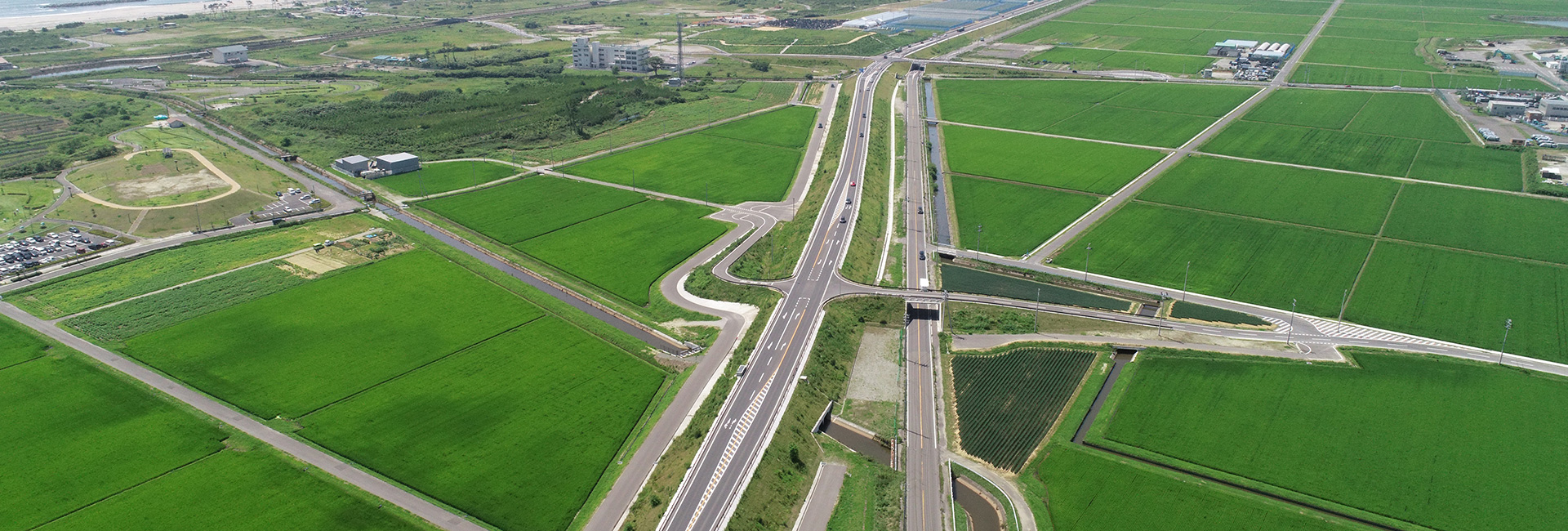
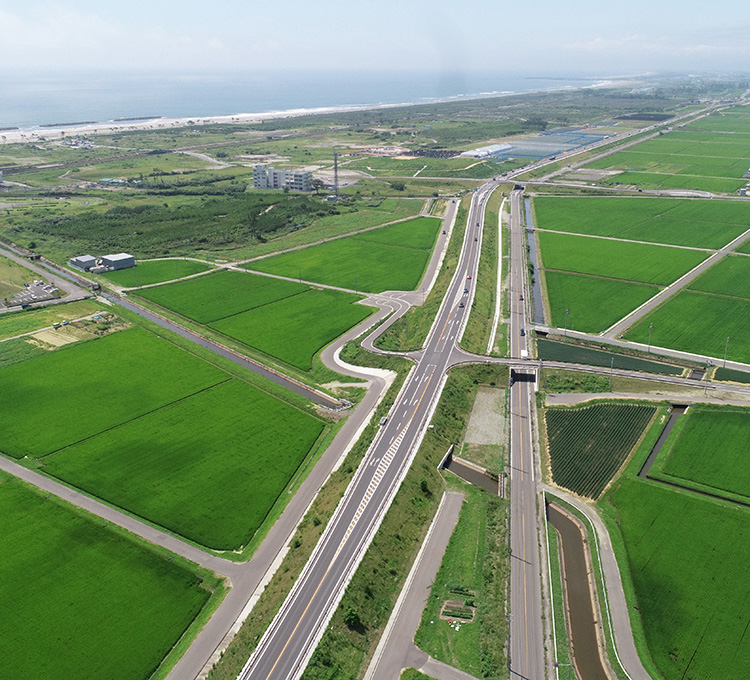
Before the disaster, the Minami-Gamo Wastewater Treatment Plant had been treating about 70% of Sendai’s sewage. On March 11, 2011, a tsunami of over 10 meters in height hit the plant and caused catastrophic damage with building structures broken, its machinery and electrical facilities submerged or swept away, and transmission towers collapsed, resulting in the shutdown of sewage treatment functions.
It was imperative to restore the plant promptly, since it was an indispensable to the everyday lives of the residents in Sendai. Along with removing debris from the tsunami and restoring the facilities and equipment at the plant, we held discussions on how to implement quick recovery. In September 2011, a restoration policy was decided to restore the plant with better functions than it had previously. It took one year to complete the design of a new plant. The plant was constructed in around three years while successfully reducing construction time from the average of ten years that are usually required to complete such projects.
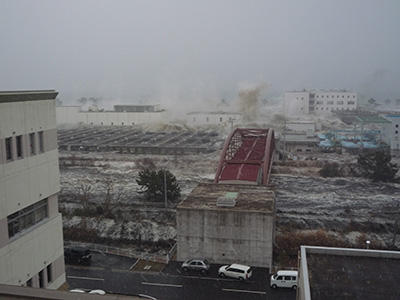
tsunami on March 11, 2011
A new plant with energy saving features and low environmental impact
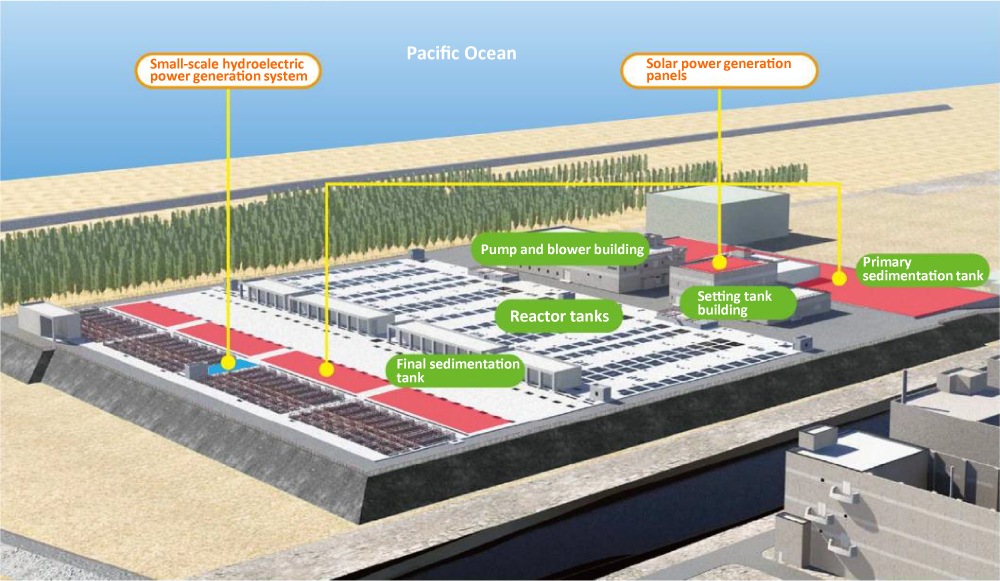
Through installing the initial sedimentation basin and final sedimentation basin on two levels and adopting deep reactor tanks, the new facility is more compact than before; moreover, it has been built to withstand a tsunami of the size experienced in the Great East Japan Earthquake through elevating the facility to tsunami wave height T.P.+10.4m (※) and installing water-resistant doors.
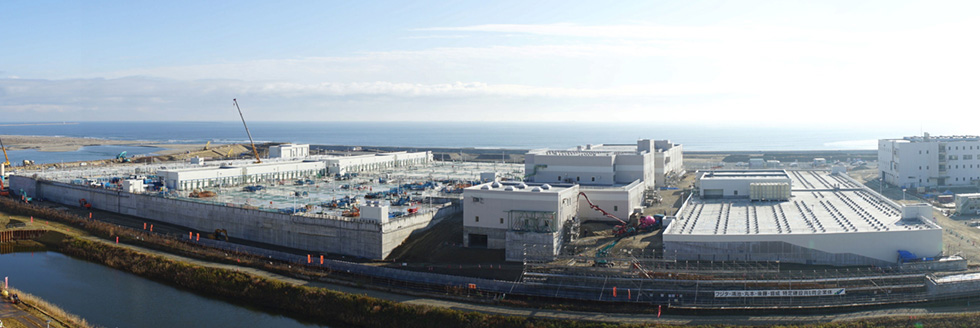
almost complete
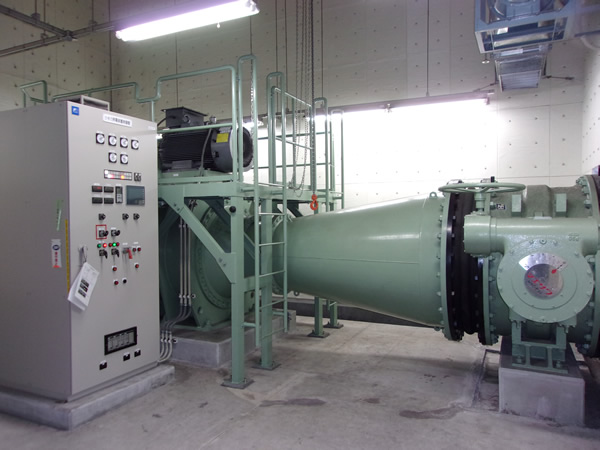
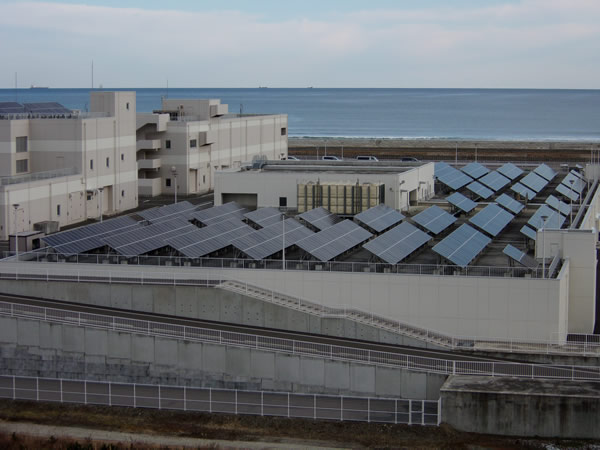
Moreover, even if power is interrupted and the pumps cannot be used, a route for conducting the minimum treatment and discharge of sewage has been secured, and solar power generating equipment has also been installed. A micro-hydropower system has also been installed to limit use of electricity.
The Sendai Framework for Disaster Risk Reduction incorporates the principle of “Build Back Better”. This means that, when conducting recovery in the wake of disasters, rather than simply restoring facilities to the same state they were in before disaster, they are made even better in readiness for the next disaster. Minami-Gamo Wastewater Treatment Plant is a prime example of this principle being put into action.
※T.P. (Tokyo Peil) refers to Tokyo Bay mean sea level, which is the reference point for level surveying in Japan.
Inquiries
Minami-Gamo Wastewater Treatment Plant,
Construction Bureau
kos011170@city.sendai.jp
Sewerage Business Continuity Plan
This business continuity plan consists of two parts, namely ‘Earthquakes and Tsunamis(2022)’ and ‘Heavy Rainstorms (Revised April 2025)’. The plan was formulated to mitigate the damage and recover quickly from such disasters. It predetermines responses and actions that staff members should take when a disaster occurs.
When the 2011 disaster occurred, quick initial responses were available. This was due to the fact that the sewage disaster response manual had been created in FY 2006 and development of a sewerage business continuity plan began in 2010.
Inquiries
Sewerage and Pipeline Coordination Section,
Construction Bureau
ges011120@city.sendai.jp
Earthquake Countermeasures
Construction of Sendai City’s sewerage utility dates back to 1899, however, the aging sewerage facilities lack earthquake resistance when measured against modern earthquake-resistance standards and there is risk that damage to sewers induced by seismic motions could cause flow functions to be lost and roads to collapse and so; hence it is urgently necessary to take countermeasures.
Following damage in the Great East Japan Earthquake, Minami-Gamo Wastewater Treatment Plant, which is Sendai’s most important sewage treatment facility, was restored based on the current earthquake-resistance standards, while other treatment plants and pump stations are successively being strengthened to withstand earthquakes.
Meanwhile, concerning sewers, since the No. 1 and No. 2 Minami-Gamo trunk lines, which are the most important sewers, cannot be surveyed due to always being filled with water, new trunk lines are being constructed to take on their burden. After they are completed, No. 1 and No. 2 Minami-Gamo trunk lines will undergo internal inspection and seismic strengthening as needed. As for other sewers, measures are being implemented on deteriorated sewers in built-up areas that lack earthquake resistance.
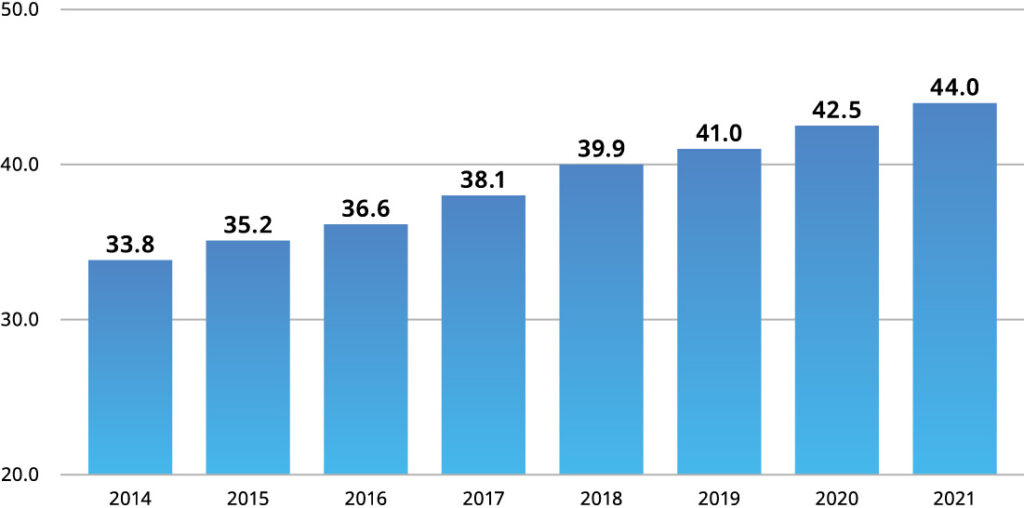
Earthquake-proof retrofitting rate of sewer pipes
Inquiries
Sewerage Planning Section,
Construction Bureau
ges011210@city.sendai.jp
Sewerage and Pipeline Coordination Section,
Construction Bureauges
011120@city.sendai.jp
Asset Management of Sewerage Works
What is Asset Management
There is no legally set definition for asset management in sewerage works. However, the Sendai City Sewerage Works defines the term as follows: “When the present status of service, potential operational risks, and required budget are evaluated and kept in an ideal balance when operating sewerage works in order to keep them functioning as intended.” The overall framework, comprised by the various tools and techniques, etc. required for asset management initiatives, is referred to as the asset management system.
Acquisition of Japan’s First ISO 55001 Certification
In FY 2013, the Water Pipeline Construction Section of Sendai City sewerage business acquired Japan’s first certification under the international standard ISO 55001 Asset Management System.
While conducting asset management activities, it was made clear that sewage pipes and facilities could be maintained in sound condition for about 1.5-2 times longer than their standard service life, and it is anticipated that through implementing life extension measures and renewals at appropriate times, lifecycle costs can be reduced. Moreover, during the Great East Japan Earthquake, through the utilization of asset management and the information system implemented alongside it, it was possible to smoothly conduct damage investigations.
Improvement of most of the sewage facilities in Sendai had been completed by FY 2008. In future, it will be necessary to promote measures against disasters such as earthquakes and flooding in addition to facility maintenance and renovation. In spite of limited resources such as budgets and personnel, we intend to run the utility steadily and efficiently and ensure the safety of the facilities by utilizing asset management to prioritize the most important projects and estimate cost over the long term.
Conveying Experiences and Lessons Overseas
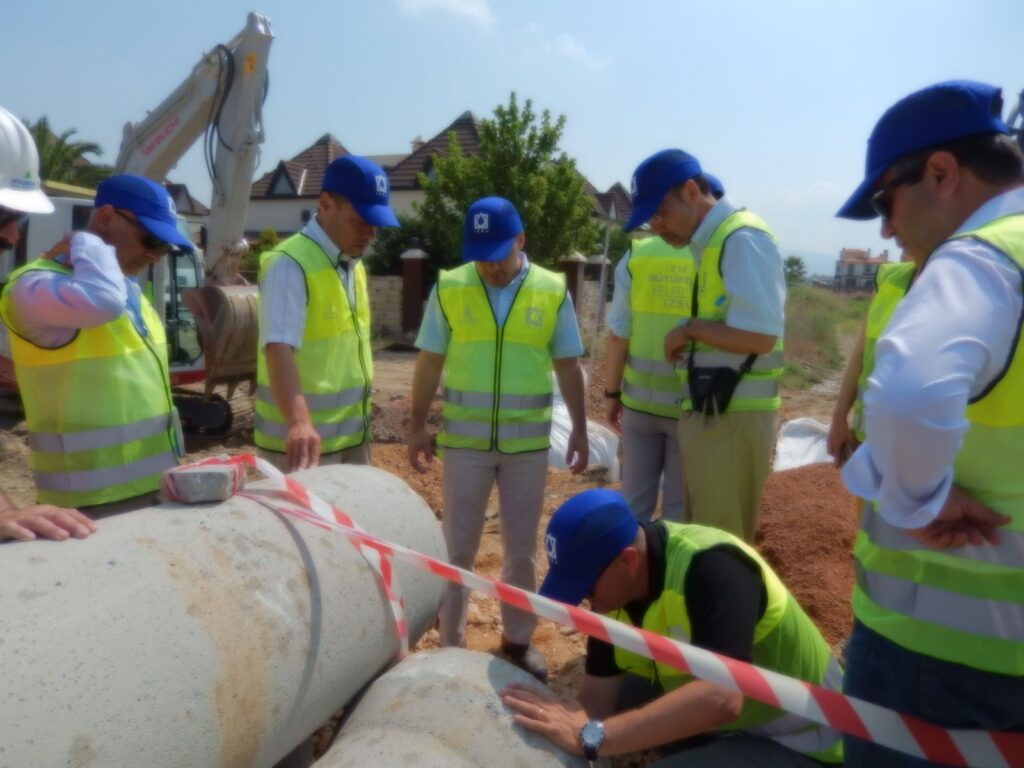
With the cooperation of the Ministry of Land, Infrastructure, Transport and Tourism and the Japan International Cooperation Agency (JICA), Sendai City provided technical cooperation with the City of Izmir in Turkey and other countries, via means such as domestic training, sending staffs, which are related to disaster risk reduction and asset management. Sendai City will continue to convey the valuable experience and lessons learned from the disaster overseas.
- Links
DRR Practice⑧ Applying the Build Back Better strategy to sewage facilities (Minami-Gamo Wastewater Treatment Plant)
Inquiries
Business Planning Section,
Construction Bureau
ken010020@city.sendai.jp