
Disaster Countermeasures for Critical Infrastructure
During the Great East Japan Earthquake, the earthquake and tsunami caused water supply to be interrupted to roughly half of all households, while supply of city gas and electricity (provided by a private sector company) was interrupted to all households. While coastal wastewater treatment facilities suffered devastating damage from the tsunami, Sendai’s gravity-flow sewerage system—designed to utilize natural elevation differences—was able to maintain its flow function. To further enhance safety and resilience, we are advancing measures such as seismic reinforcement of pipelines and facilities, the establishment of dual water supply systems, and the installation of emergency gas receiving facilities to strengthen backup functions. In addition, we are implementing countermeasures such as formulating business continuity plans (BCPs) to support rapid recovery and reconstruction.
Water Supply
Various countermeasures have been implemented in Sendai City based on lessons learned from the 1978 Miyagi-Oki Earthquake, such as adopting pipe materials with a certain level of earthquake resistance when renewing or installing new pipelines. However, during the Great East Japan Earthquake, although these countermeasures contributed to early recovery, significant damage still occurred, with about half of all households in the city affected by water outages. In light of this experience, the city has reviewed the effectiveness and issues of its past disaster countermeasures and is working to build a more disaster-resilient water supply system.
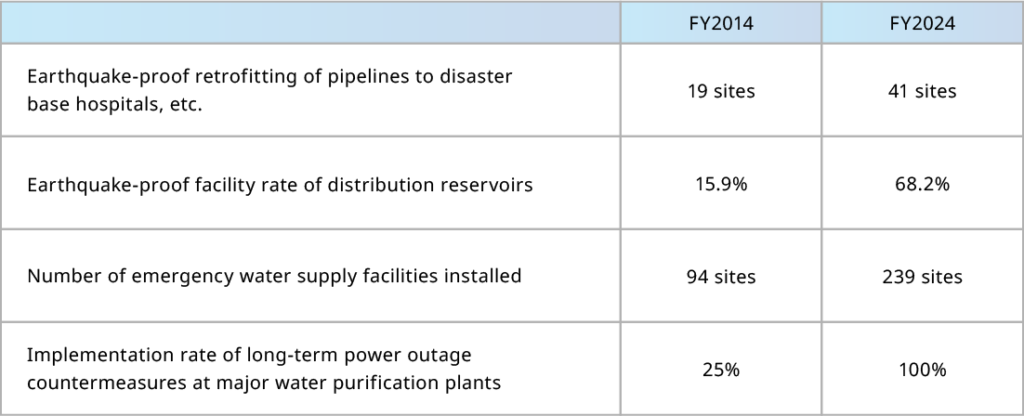
Currently, in addition to earthquake-proof retrofitting of facilities such as pipelines to disaster base hospitals, water purification plants, and distribution reservoirs, the city is also enhancing long-term power outage countermeasures by expanding fuel tanks for emergency generators at key water purification and distribution facilities and pump stations. Emergency water supply faucets are being progressively installed at designated evacuation sites such as municipal elementary, junior high, and high schools, enabling local residents to independently establish and use water supply stations during disasters. Once installation is complete, the city explains how to use them and promotes water stockpiling, as part of efforts to strengthen disaster response capabilities in collaboration with community-based self-help and mutual aid.
Chart: Trend in the earthquake-proof retrofitting rate of critical infrastructure (water pipelines)
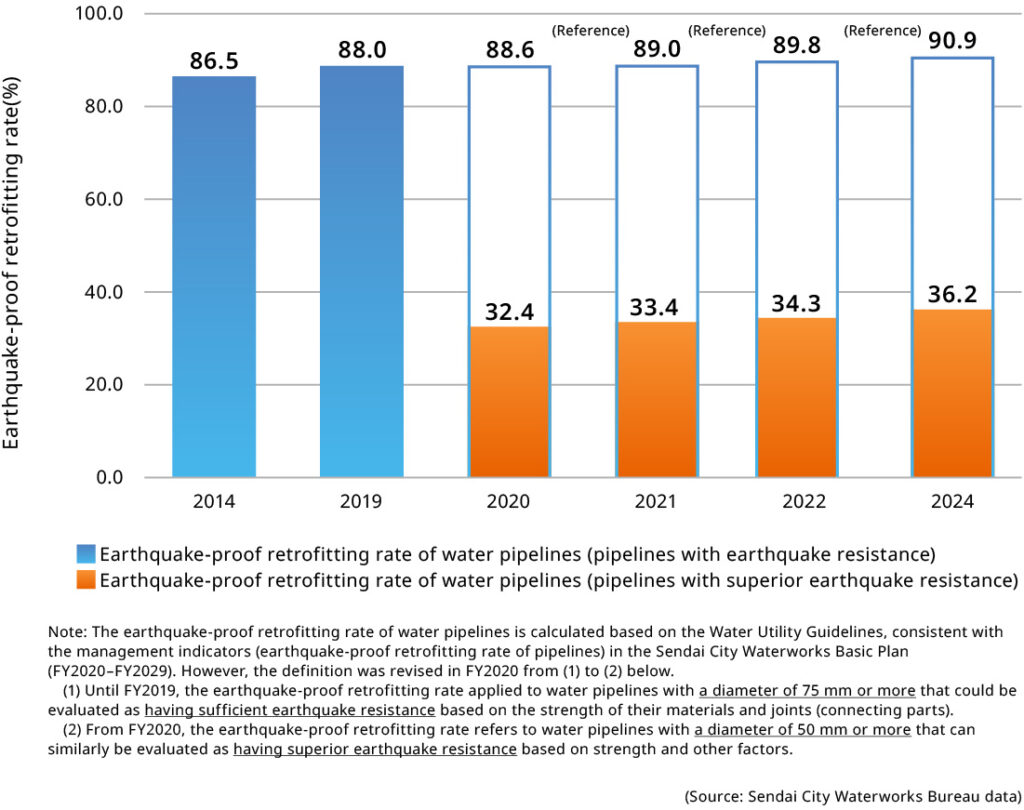
Key performance indicators for disaster countermeasures in the water supply project
- Links
DRR Practice⑧ Applying the Build Back Better strategy to sewage facilities (Minami-Gamo Wastewater Treatment Plant)
https://www.suidou.city.sendai.jp/nx_html/09-bousai/09-000index.html
Inquiries
General Affairs Section,
Waterworks Bureau
Sewerage
Earthquake-proof retrofitting of sewerage facilities
Inquiries
General Affairs Section,
Waterworks Bureau
Gas
Based on lessons learned from past major earthquakes, Sendai City has implemented seismic countermeasures to ensure the stable supply of city gas while preventing secondary disasters such as gas leaks. These include earthquake-proof retrofitting of gas pipelines, duplicating and block segmentation of supply lines, and collaboration with the Japan Gas Association and city gas suppliers nationwide. During the Great East Japan Earthquake, gas production and supply facilities suffered severe damage from the earthquake and tsunami, forcing a complete shutdown of gas supply to approximately 360,000 households in the city. However, about 90% of the supply was restored roughly one month after the disaster, sooner than originally planned.
In response to the significant impact on residents caused by the full shutdown, the city is taking both structural and non-structural measures to ensure safe and stable gas supply under any circumstance. These include establishing emergency gas receiving facilities inland, strengthening earthquake resistance of gas pipelines, implementing tsunami countermeasures for production facilities, subdividing disaster response blocks, and revising disaster response manuals.
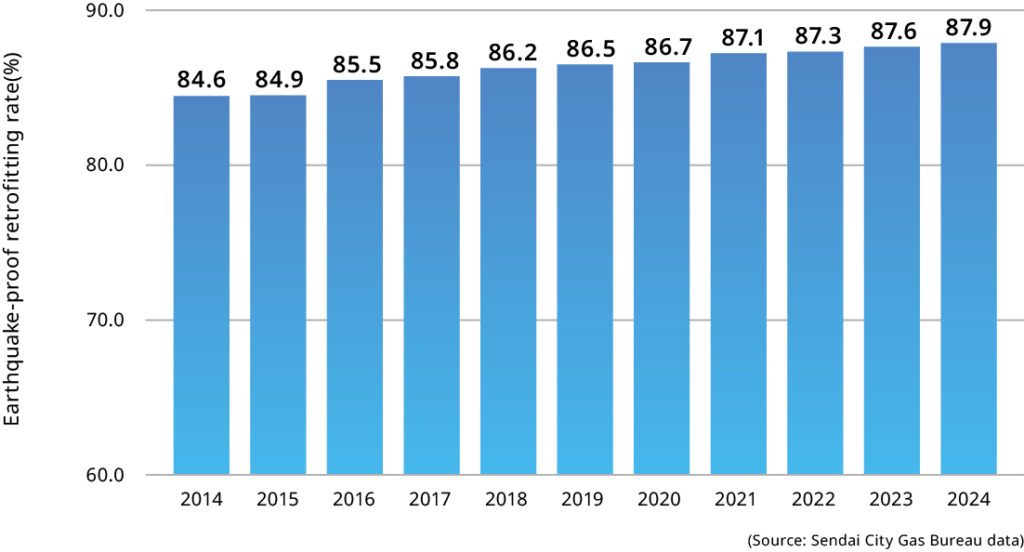
Chart: Trend in the earthquake-proof retrofitting rate of critical infrastructure (gas pipelines)
Inquiries
General Affairs Section,
Gas Bureau